Riding weather
Motorcycle Wind Chill Calculator
What does 35°F really feel like at 70 mph? Plug in temperature and ride speed and find out before you grab a helmet.
The formula
RiderCalc uses the National Weather Service 2001 wind-chill model — the same formula the NWS, Environment Canada, and most weather apps switched to after the older Siple-Passel model was retired.
Imperial (°F, mph):
WC = 35.74 + 0.6215·T − 35.75·V^0.16 + 0.4275·T·V^0.16

Metric (°C, km/h):
WC = 13.12 + 0.6215·T − 11.37·V^0.16 + 0.3965·T·V^0.16

Where T is air temperature and V is wind/ride speed.
On a motorcycle, V is your ride speed plus headwind, not the meteorological wind. That single substitution is why an idle weather-app wind chill of "feels like 30°F" turns into a brutal 8°F when you’re doing 65 on the interstate.
Worked example
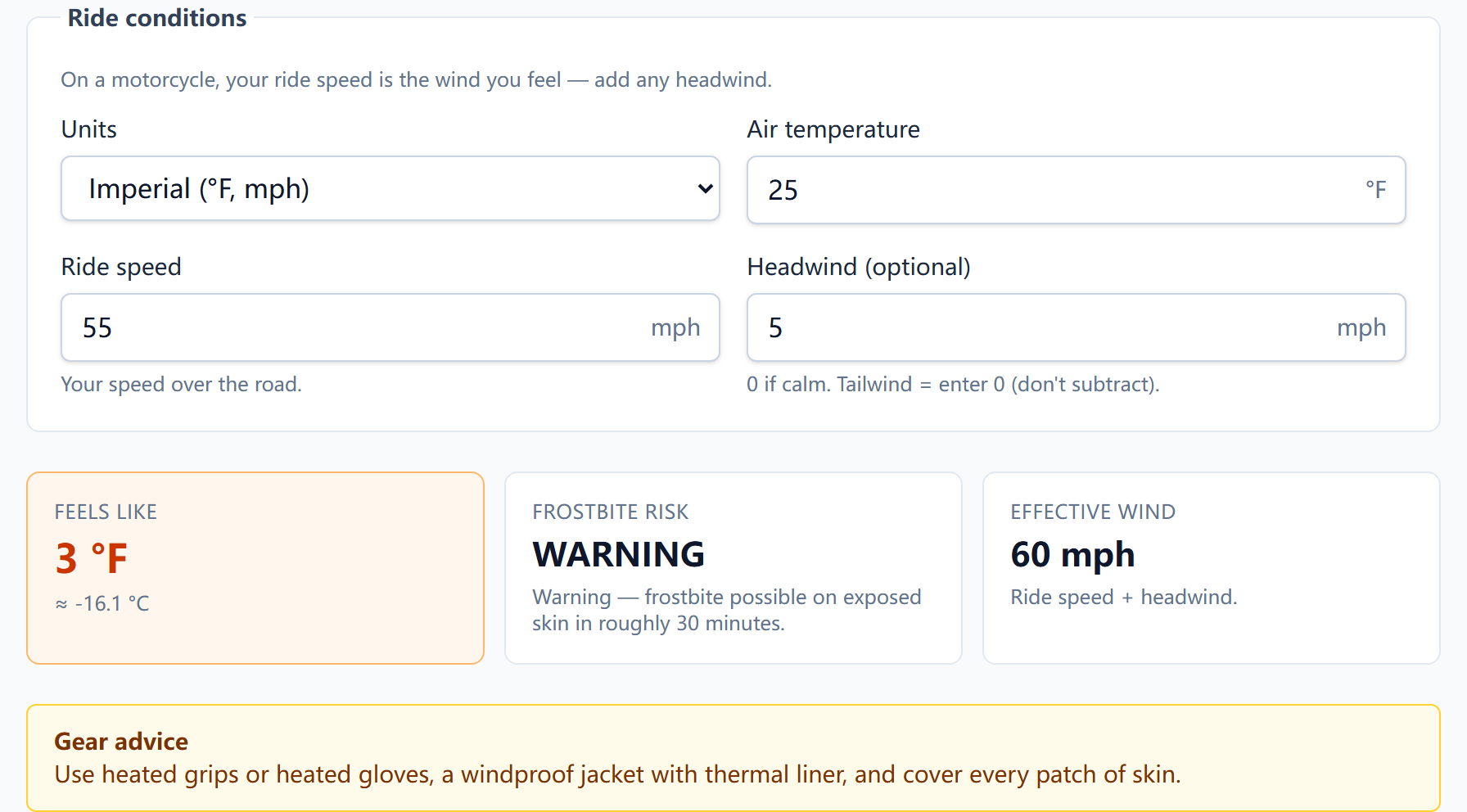
It is 25°F outside, you are cruising at 55 mph with a 5 mph headwind, so V = 60 mph:
- V0.16 = 600.16 ≈ 1.929
- WC = 35.74 + 0.6215·25 − 35.75·1.929 + 0.4275·25·1.929
- WC ≈ 35.74 + 15.54 − 68.96 + 20.62 ≈ 2.9°F
Frostbite-risk band: "warning" — exposed skin can frostbite in about 30 minutes. Heated grips, a windproof jacket with thermal liner, and a neck gaiter are the minimum.
How felt temperature drops with ride speed
Wind chill is non-linear: the first 15 mph of speed removes most of the felt warmth, and adding more speed makes diminishing extra impact. The curves below — computed straight from the NWS formula — show this clearly. Going from a 30 mph back-road pace to a 75 mph highway pace adds only a few degrees of additional chill; getting on the bike in the first place is what changes things.
Wind chill chart for typical riding speeds
Pre-computed felt temperature (°F) using the NWS 2001 formula for the speeds you actually ride at. Read down for air temperature, across for ride speed. Cells shaded orange to red are progressively higher frostbite risk on exposed skin.
| Air temp ↓ / speed → | 15 mph | 30 mph | 45 mph | 60 mph | 75 mph |
|---|---|---|---|---|---|
| 50 °F | 45 | 42 | 40 | 39 | 38 |
| 40 °F | 32 | 28 | 26 | 25 | 23 |
| 30 °F | 19 | 15 | 12 | 10 | 9 |
| 20 °F | 6 | 1 | −2 | −4 | −6 |
| 10 °F | −7 | −12 | −16 | −19 | −21 |
| 0 °F | −19 | −26 | −30 | −33 | −36 |
The NWS frostbite-risk threshold for exposed skin in under 30 minutes is roughly 0 °F felt; under 10 minutes is roughly −18 °F felt. Anything in the orange/red cells means full coverage and no skin showing.
Gear by felt temperature
Reading the chart above? Match the felt temperature to the gear column. This is the layering ladder most year-round commuters end up at after a few cold mornings.
| Felt temp | Hands | Core | Head / neck |
|---|---|---|---|
| ≥ 50 °F | Vented summer gloves | Mesh / textile jacket, thin base layer | Open / vented helmet OK |
| 35–50 °F | 3-season gloves with cuff | Windproof shell + thermal liner | Full-face, neck gaiter |
| 20–35 °F | Heated grips OR insulated winter gloves | Thermal mid-layer + windproof shell | Full-face, balaclava, anti-fog visor |
| 0–20 °F | Heated grips + heated gloves | Heated jacket liner under windproof shell | Full-face, thermal balaclava, breath deflector |
| Below 0 °F | Heated gloves + bar muffs | Heated vest + heated jacket + heavy shell + heated pants | Full-face, electric visor or breath deflector mandatory |
Heated grips ($80–250 installed) are the highest-ROI cold-weather upgrade. Heated gloves run $200–400 and need a battery harness. Heated jacket liners ($150–350) are what makes 0 °F rides survivable.
Formula source: NWS 2001 Wind Chill formula (weather.gov). Last reviewed: . Reviewed by the RiderCalc editorial team.
Frequently asked questions
Is a "motorcycle wind chill" different from a normal wind chill? +
The formula is the same. The difference is the wind speed: weather forecasts use the actual atmospheric wind, but on a bike the wind you feel is your ride speed plus any headwind. At a 55 mph cruise the air over your hands is effectively a 55 mph "wind" — even if the air outside is still.
What formula does this use? +
The National Weather Service 2001 wind-chill formula. In imperial units: WC = 35.74 + 0.6215·T − 35.75·V^0.16 + 0.4275·T·V^0.16, where T is air temperature in °F and V is wind in mph. It is calibrated for T ≤ 50 °F and V ≥ 3 mph; outside that range the result is shown as a rough reference.
How cold is too cold to ride? +
It depends on your gear, your trip length, and your tolerance. As a guide: above ~32 °F felt is comfortable in standard textile gear, 16–32 °F demands a thermal base layer, 0–16 °F realistically needs heated grips or gloves, and below 0 °F you want full electric heat. The calculator’s "frostbite risk" line is the NWS exposure scale.
Does the formula handle hot weather or "heat index"? +
No — wind chill only models heat loss in cold air. Above about 50 °F the calculator still shows a number but flags it as outside the NWS-calibrated range. For warm-weather effective temperature use a heat-index calculator instead.
Should I add the actual outdoor wind to my ride speed? +
Add a headwind to your ride speed. A 10 mph headwind on a 55 mph cruise is a 65 mph wind on your chest. A tailwind technically cancels some of your forward speed, but you should not enter a negative value — the formula misbehaves at very low V.